China report: China Rising
|
Dongtan City: An eco exemplar
Dongtan is planned as a development of three villages that join together to form a city centre. It is designed to run entirely on renewable energy for its buildings, its infrastructure and its transport needs and will recover, recycle and reuse 90% of all waste in the city, with the eventual aim of becoming a zero-waste city. Arup’s masterplan includes a combination of traditional and innovative building technologies which will reduce energy requirements by around 66%, saving an estimated 350,000 tonnes of CO2 per year. It is designed so that all housing will be within seven minutes walk of public transport and with easy access to social infrastructure such as hospitals, schools and work. Dongtan will produce suffi cient electricity and heat for its own use, entirely from renewable sources, including wind farms, biogas (extracted from the treatment of municipal solid waste and sewage), and photovoltaic cells and micro wind turbines sited within buildings. There will be practically no emissions from vehicles – vehicles will be battery or fuel-cell powered. A combination of cycle-paths, pedestrian routes and varied modes of public transport, including buses and water taxis, will be provided to circulate citizens around the city.
Client: Shanghai Industrial Investment Corporation Masterplanning / sustainability guidelines: Arup
Size: 86 square kilometres
Completion date: Linking bridge to complete by 2009
|
There are more than 320,000 hospitals and clinics in China, most of them either undergoing – or needing – refurbishment. What opportunities are being created for enlightened and progressive new healthcare buildings? Veronica Simpson reports.
It would be impossible to calculate the billions that have been spent transforming China’s cities in the last five years, as that great, once communist nation embraces consumerism, capitalism and modernity.
But while western eyes widen in amazement as shiny steel and glass skyscrapers and 12-lane highways are constructed in a matter of months by the vast Chinese workforce, there has been growing concern that, in the rush to dazzle the world’s TV cameras assembled for this year’s Olympics, little or no attention has been paid to infrastructure.
The health and wellbeing of the community certainly seems secondary to the lust for new, statement office blocks and stadia. International architecture practices are generally steering clear of involvement in healthcare projects – even if they’re active in other sectors in China – because of a perceived diffi culty in achieving quality outcomes, or realistic fees.
Brad Barker, managing director for RTKL’s healthcare practice worldwide, says: “Quality healthcare is beginning to emerge as a priority, but not at the pace of commercial development. In addition, most commercial development is driven by entrepreneurial ventures, while healthcare is a function of the government and, therefore, lacks the competitive element that drives a commercial project.”
He admits the practice has had its fingers burnt by a common tendency to bring in international consultancies for design inspiration and then leave them high and dry. “I must admit our two experiences have not been positive. In both cases we were never paid in full for our planning/design services and as a result, we are not spending much time on this market.”
Despite having offices in the region, Steffian Bradley, Atkins and NBBJ have, for now, also steered clear of any healthcare projects, as has Llewelyn Davies Yeang (LDY). But it’s not as though China doesn’t have enough of its own architects to take care of business. As LDY principal Ken Yeang points out, whether they operate within the remnants of the vast municipal architecture institutes or as part of the burgeoning private practice scene, China has many excellent architects, most of them trained at the best UK and US architecture schools.
|
The 500 bed Tianjin Children's Hospital, designed by TRO Jung|Brannen
|
However, Memphis, Tennessee-based practice TRO Jung|Brannen has made inroads here. Its relationship with the region goes back some 15 years, when a young Chinese graduate intern, Kai Wang, first suggested sharing the practice’s healthcare knowledge with China’s medical fraternity at various seminars. Wang is now running its office in Beijing.
TRO Jung|Brannen’s first project was the 600-bed, 60,000 square metre Shanghai East Hospital, which had to be constructed in three phases, on the same site as the existing hospital, to keep the building operational throughout.
East meets west
Keen to incorporate the best of Western practices with those of the East, TRO Jung|Brannen had to accommodate many cultural differences. Principal David Rhodes says: “In China the hospital is the centre of all healthcare. People come there for everything – treatments, checkups, visits to all outpatient clinics. So we had to accommodate large volumes of people. We put in big windows, and were able to bring a lot of daylight into where the diagnostic clinics and outpatient clinics were.
“In China there is a strong preference for all patient rooms facing south. So how do you come up with a scheme that accommodates that, but doesn’t walk the nurses to death? We actually created two nursing units, on each floor, side by side. The rooms stretch out along a semi-circular wing. The north side has all the support facilities – staff quarters, lockers – and that keeps them away from all of the patient facilities.”
|
Shenzhen Bin Hai
|
| Client |
Shenzhen Healthcare Bureau |
| Architect of Record |
Shenzhen General Architectural Design & Research Institute |
| Design Architect |
Tro Jung|Brannen |
| Structural Engineer |
Shenzhen General Architectural Design & Research Institute |
|
|
|
Since then, most of TRO Jung|Brannen’s projects have adapted this model, with southeast-facing patient rooms, natural, in-room ventilation and air conditioning only when absolutely necessary. There is strict separation of clean and soiled materials – even separate lifts.
As we know, China has a long and proven medical history of its own, and most patients these days receive both traditional Chinese and western medicine. “All the hospitals we have been in have acupuncture and traditional chinese medicine, with its own pharmacy that involves the cooking of herbs, with very strong smells. We separate that from the western pharmacy and exhaust them like a kitchen.
“In China there is more sensitivity to the (need for) daylight, more emphasis on what the patients see when they look out of the room, rather than opting for the most efficient design. We have waiting rooms with atriums, and patient recovery rooms must have outside windows.” Only radiology, surgery and laboratories are windowless. Room size is still an issue.
Says Rhodes: “We’ve been convincing them to follow US minimum guidelines, which is much larger than they are used to. It’s been a bit of a compromise. They’ll often add in extra beds. Most of the jobs we’ve done have had four-bed wards. Most of them have been semi-private. In one case we designed for four beds in each room, and they put in six. “It’s evolving. You have this emerging middle class in China that is looking for higher standards. Even though the public system is what they are using, they are willing to pay for a bit of privacy.”
But it has to be said, these new, improved hospitals are still in the minority, and only the big municipalities have the budgets to commission them.
Susan Francis of the UK’s Commission for Architecture and the Built Environment (CABE) visited Beijing, Shanghai and the surrounding countryside on a recent trip organised, during the Olympics, by the Royal Institute of British Architecture (RIBA). Her impression was that of a country in the process of “an obliteration of a culture and a bringing in of the new”. Of great concern to her, from a health perspective, was the fact that rural areas – which still constitute the vast bulk of China’s landscape – are seemingly left in the dark ages, while the cities advance at warp speed. Rhodes agrees: “District and county hospitals are in a real dilemma. They are barely buildings. There are naked light bulbs hanging from the ceilings, and no heat or air. For the country to leap from that to what we are doing is really inconceivable.”
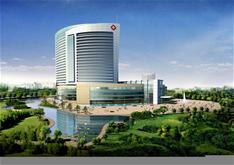 |
Hangzhou District Hospital
In the lakeside city of Hangzhou , TRO Jung|Brannen has created plans for a new district hospital for the Hangzhou municipal government, with 1,200 beds with 152,000m2. Won as part of a design competition, the mayor specifi cally wanted to see this facility as a signifi cant piece of architecture. It’s on a clean site with water features. The materials in the rectangular block are primarily stone, similar to that found on many buildings in Hangzhou, fronted by a bow-shaped glass structure. All outpatient clinics and most of the diagnostic and treatment functions are located in the rectangular block, separated from the bow-shaped structure by a central atrium/mall. All waiting rooms open onto the mall. Bridges above the first floor are used to transport inpatients across to the D/T facilities without going across the first floor of the mall. A two-level basement connects the entire structure and provides strict separation of clean from soiled traffic. A separate building houses the administrative, education, and research activities including staff dining and kitchen. There is a green roof over the D/T block, and underground parking to maximise green areas and water on site.
|
Which all adds up to a model of work and lifestyles that are far from green. But China is taking note of green concerns. Arup, heavily involved in the engineering and design of many Chinese cityscapes, has drawn up the blueprint for the futuristic, and as yet unbuilt, eco city of Dongtan, which will be constructed on the southeastern tip of Chongming Island, Shanghai.
Head of global healthcare Phil Nedin says: “The trouble with this area is high humidity. That doesn’t help us when we’re seeking low carbon solutions. But we are looking to incorporate openable windows, natural ventilation wherever possible. Healthcare design is very prescriptive, but we are trying to be as open-minded as possible. We are looking at the idea of a labyrinth (cooling and ventilation system) in the basement area, exposed concrete and high ceilings.”
However, the scheme has yet to attract sufficient backing to begin construction, and it’s notable that Arup has not exposed itself to the healthcare sector in China, yet. But things move fast in China.
A year ago, Steffian Bradley Associates CEO Kurt Rockstroh was turning down healthcare work in the region, partly because “the majority of these projects are very parochial in their approach. They are trying to bang out a lot of hospitals to cater for large numbers of people. But it is opening up. There are a few well thought-out projects that are designing for the future and better models of care, and as people see how much better that is, they will begin to demand it.”
Veronica Simpson is an architectural journalist
|

1.1.jpg)


|