6th Design & Health World Congress Review
 |
Singapore Minister for Health Mr Khaw Boon Wan
|
The four-day 6th Design & Health World Congress & Exhibition in Singapore was a resounding success, spreading knowledge and fostering dialogue between researchers and practitioners in the interdisciplinary field of healthcare design. Diana Anderson and Marc Sansom report.
Perhaps the UK’s Lord Nigel Crisp said it best at the start of his congress presentation on Global Health Partnerships: “and we meet again in wonderful Singapore, where the old meets the new and where East meets West.”
The image of this intersection between history and culture is a fitting description, both for the island of Singapore where the event took place, and as a depiction of the uniquely global character of the Design & Health community. The gathering of almost 400 delegates, including architects, designers, health administrators, economists, psychologists, clinicians, nurses, health scientists and government offi cials from more than 30 countries, to exchange research, design solutions, stimulate discussion for new ideas and find and create business opportunities, demonstrated clearly how healthcare must now be considered within a global context.
Global interdependence
Against the backdrop of rising fears over the threat of the H1N1 virus in a part of the world that has not yet forgotten the social and economic impact of SARS, our global interdependence was a lesson that remained vivid to delegates in every conversation and meeting they had, and every presentation they listened to.
It was a message that also struck home during the Singapore’s Minister for Health, Mr Khaw Boon Wan, opening speech. In an impressive demonstration of knowledge of the past fifty years of progress in healthcare within Singapore, Khaw Wan Boon, described the country’s achievements in developing one of the most effi cient and effective health systems in the world, whilst looking forward to the future and the health and design challenges of ageing populations, technological advances, and infectious disease spread by every nation.
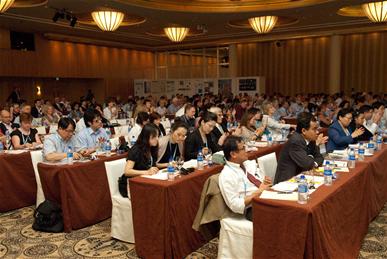 |
Delegates from 30 different countries filled the Grand Ballroom at the Ritz Carlton every day
|
Lord Crisp, who without the use of slides, discussed how our global interdependence had created the conditions for greater collaboration between the developed and the developing world, reinforced the need for a global perspective on these modern 21st century issues. “Increasing globalisation has allowed for the greater sharing of knowledge and experience, but has allowed diseases to travel, whilst the health impacts of climate change will be damaging for us all,” he said, arguing that there are new opportunities for, “learning together how to operate efficiently and effectively within an environment where resources, carbon-based and fi nancial, are in increasingly short supply.”
The important notion that design and health also reinforce each other was presented through a series of 12 sessions over three days, each session featuring 3-4 speakers followed by a question and answer period. Themes of the sessions included such topics as: New Paradigms in Design and Health; Health and Healthcare Design in Singapore, China, Korea and the Middle East; Humanistic Architectural Responses in Health Design; Design and Health Impacts on Patients, Staff and Visitors; Cultural Perspectives and Global Health Partnerships; Improving Organizational Image and Performance; Designing Environments for Children and Senior Care; and Designing Institutional Environments that Care.
 |
Showcases
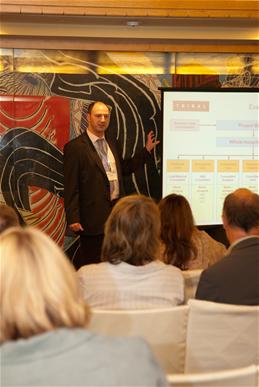
During the lunchtime period each day, the Design & Health ‘Sponsored Showcases’, provided a more informal environment for discussion on key topics, such as: the operating room of the future; achieving design quality in PPP (Public Private Partnership); good preparation and briefing in building design; and the experience of lighting in the hospital of tomorrow. Here, Craig Dixon of Tribal describes to healthcare practitioners how good preparation and briefing leads to stronger engagement and subsequently, better facility design. In addition, over 20 posters were displayed on a wide scope of topics within the main gathering space for the congress, where delegates could examine the research and projects at their own pace, while also generating discussion over the topics. |
New generation
Across the world, investment in healthcare infrastructure is a major priority for governments over the next 10-15 years, and it is no exception in Singapore. In the morning session on the first day, which focused largely on Singapore’s own approach to healthcare delivery, Liak Teng Lit, chief executive officer of Alexandra Health and Ruby Lai, senior consultant at CPG Consultants, explained how new projects will have a different emphasis from the hospitals constructed in the previous decade. “Greater focus would be placed on ensuring hospitals were patient centric – friendly and welcoming. The hospitals will be designed with flexibility in mind to cater for rapid changes in medical treatment.
 |
Matthew Saunders of Broadway Malyan demonstrates Singapore's new National Heart Centre design to Minister for Health, Mr Khaw Boon Wan (centre) and (from left) Liak Teng Lit, Alexandra Health; Steven Sobak, SingHealth; John Ting, Singapore Institute of Architects past president; and Prof Alan Dilani
|
Greater emphasis will also be placed on thermal comfort, energy efficiency and conservation of resources,” they said. Incorporating many of these key features, the new Khoo Teck Puat Hospital, visited by many of the delegates on the study tours, was described by Liak Teng Lit as the first of a new generation of hospitals, that will set a new benchmark for healthcare design, not only in Singapore and Asia, but potentially the rest of the world.
The theme of how a shift in emphasis towards a greater understanding of salutogenic health and how the environment can be used as a tool for preventative medicine as a means of promoting and supporting health processes, was common throughout the sessions.
One of the highlights for many delegates was the approach taken by Tye Farrow of Farrow Partnership Architects, who in his paper, ‘Bringing Hospitals to Life: Design Quality Standards’, drew on the research of Harvard biologist, E O Wilson, who suggested that an innate human desire for close contact with the natural world occurs on a physical, emotional and intellectual level. By identifying international benchmarks, Farrow called for design standards to be anchored in biophilia research and the need to work with the power of nature and not against it.
Farrow’s ideas were reinforced by Kristen Whittle’s description of the design of the new Royal Melbourne Children’s Hospital, which was inspired by the surrounding parkland setting of Royal Melbourne Park. Said Whittle: “The ‘park in the building’ concept has influenced every aspect of the hospital planning and has been carried through into the material expression of the building, by using the natural textures, forms and colours of the park.”
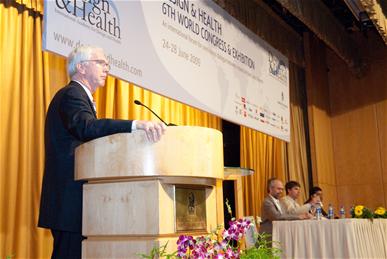 |
Session chair, Dr Ray Pentecost takes questions from the audience to John Steven, Stantec; Tye Farrow, Farrow Partnership Architects and Ashikur Rahman Joarder, Health and Care Infrastructure Research Centre, UK
|
Architecture of incarceration
The emphasis of how health and design relate to the wider social, cultural and political context was expressed through several sessions, most notably by the discussions on the architecture of incarceration. Here, Lord Crisp returned with Chris Liddle of HLM Architects, to present a paper on how to create custodial facilities where a combination of dignity and care, education, community and overall environment contribute to the ultimate goal of rehabilitation in society and the prevention of reoffending.
Posing as client and architect respectively, together they challenged the audience to seek out new perspectives on health promotion from a wider societal point of view, calling for greater research into the designs that promote prisoner health and the use of prisoner reference groups.
This reinforcement of design and health as a larger social issue which reaches beyond the realms of science and technology was a recurring theme during the congress, emphasising the fact that health, social, cultural and political issues are deeply intertwined.
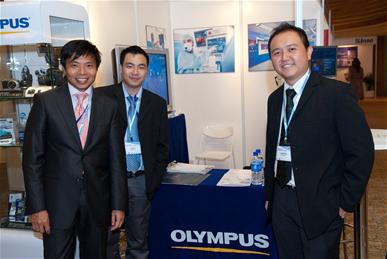 |
| The Olympus exhibition booth where delegates could be found discussing the future of operating theatre design |
In the words of Oliver Wendel Holmes: “Many ideas grow better when transplanted into another mind than in the one where they sprang up.” With a major investment in the healthcare built environment currently underway worldwide, never before has it been so necessary to develop new evidence-based research and design solutions. The notion of flexibility in design and the adaptation of existing health buildings are no doubt as important as the challenge of developing new facilities. By coming together and sharing interdisciplinary ideas and viewpoints through this type of congress, the opportunity to solve these existing and future challenges through a shared vision becomes much more achievable.
Click here for copies of the presentations from the 6th World Congress event in Singapore
Diana Anderson, MD, MArch is an architect with WHR Architects
Marc Sansom MBA is the editorial director of World Health Design
The 7th World Congress & Exhibition will be held in two years’ time from 29 June-3 July in Boston, Massachusetts, USA. The Call for Papers will be published in October 2009. For more information, visit www.designandhealth.com or contact Prof Alan Dilani at [email protected] or Marc Sansom at [email protected]
|

1.1.jpg)


|